

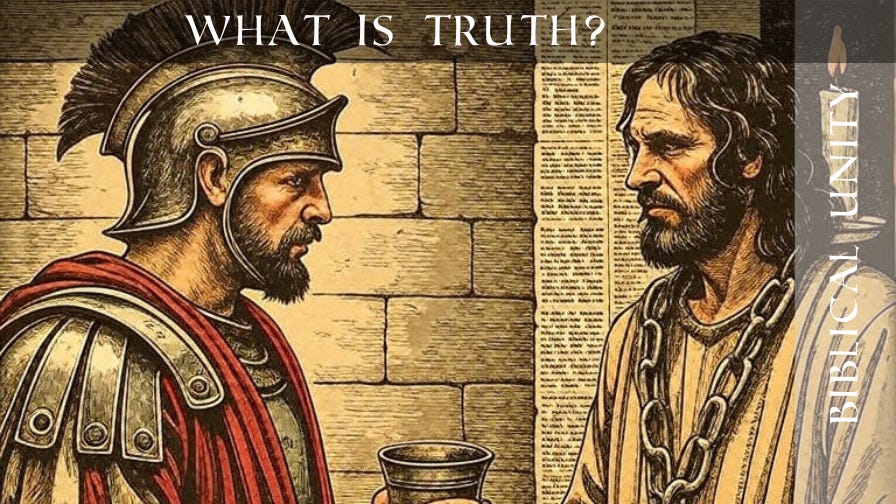
In the dimly lit chambers of Roman authority, Pontius Pilate posed a question that has echoed through the ages: “What is truth?” (John 18:38). Standing before him was Jesus of Nazareth, who had just claimed His purpose was to “bear witness to the truth” and that “everyone who is of the truth hears My voice.” Pilate’s inquiry, whether a cynical retort or a genuine plea, cuts to the core of human existence. It is a question that demands an answer, for to live without grappling with truth is to drift aimlessly in a sea of chaos.
This exploration is not just academic. Truth shapes how we live, face suffering, and fulfill our calling; whether raising a family, building a community, or, as Scripture urges, making disciples of all nations (Matthew 28:19). From ancient thinkers and biblical figures to modern philosophers, humanity has wrestled with truth. Yet, the Bible offers a profound vision: truth is not merely an idea but a person, Jesus Christ, who declares, “I am the way, the truth, and the life” (John 14:6). Let us journey through the origins of this struggle, early witnesses, philosophical perspectives, and biblical revelation to see what truth demands of us today.
Early Witnesses to Truth
The need to understand truth begins in the Garden of Eden, where Satan, disguised as a serpent, posed a deceptive question: “Did God really say, ‘You must not eat from any tree in the garden’?” (Genesis 3:1). This was the first challenge to truth, a subtle twist that introduced doubt and distorted God’s clear command. By questioning divine authority, Satan sparked humanity’s fall, and ever since, we have grappled with discerning truth from deception. This moment marks the inception of our quest for truth, revealing its vital role in our relationship with God and our ability to live authentically.
Truth through integrity?
From this fractured start, biblical figures like Job, Abraham, and Moses engaged with truth in their own ways. Job, a man of Uz, embodied truth through integrity. Described as “blameless and upright” (Job 1:1), he lost everything... wealth, children, health (Job 1:12-19; Job 2:7); yet declared, “Till I die I will not put away my integrity from me” (Job 27:5). His hope in a Redeemer (Job 19:25) points to Christ, the truth (John 14:6).
Truth through faith and as divine law?
Abraham wrestled with truth through faith. Despite his age, he trusted God’s promise of a son (Genesis 15:6), even when called to sacrifice Isaac (Genesis 22:2). Moses delivered truth as divine law, with commands like “You shall not bear false witness” shaping a holy people (Exodus 20:16). These lives rooted truth in God, equipping disciples to share it globally.
Truth as moral order and hidden?
Other ancient authors beyond Scripture engaged wanderings and ponderings about truth. Although they were far from God, some of their thoughts reflect being created in His image. Egypt’s Ma’at symbolized truth as moral order, guiding just living. Scripture also connects these concepts, through Job’s uprightness or Solomon's proverbs (Proverbs 12:22). In Greece, Heraclitus saw truth is hidden in plain sight declaring "Nature loves to hide", which sounds very similar to Proverbs 25:2, “It is the glory of God to conceal a matter, but the glory of kings is to search out a matter”.
Truth as an unchanging reality grasped by reason?
Parmenides argued for truth as an unchanging reality grasped by reason. Parmenides, to our knowledge, did not follow the One True God, but even so, he stumbled on the fact that Truth never changes (Hebrews 13:8). These early efforts reflect a universal longing for truth by humankind, it is fully realized in Jesus, though some will acknowledge Him and some will not.
Philosophical Perspectives on Truth
Truth as something eternal?
These early witnesses reflect humanity’s deep longing for truth. Building on these foundations, Greek philosophers like Plato began to systematize this quest, offering theories that have echoed through history. Plato saw truth as something eternal, residing in a realm of perfect forms, beyond the shadows and flux of the physical world. In his Republic, he paints a picture of prisoners in a cave, mistaking flickering shadows for reality. Truth, according to Plato, is the blinding light outside the cave, grasped only through reason and the soul’s ascent. It’s a noble vision, one that lifts our gaze upward, beyond the muck of daily life.
Truth if it matches reality?
Then comes Aristotle, Plato’s pupil, who drags truth back to earth. In his perspective, truth is about correspondence: a statement is true if it matches reality. “To say of what is that it is, and of what is not that it is not, is true,” he writes in his Metaphysics. It’s practical, grounded; truth becomes a matter of aligning words with the way things are. You can feel the weight of the world in this view, a call to observe and speak plainly.
Truth begins with self existence?
Moving to the 17th century, René Descartes sought certainty. He doubted everything such as senses, traditions, even his own body, until he hit his thesis: “I think, therefore I am.” That single idea became his anchor, a foundation to rebuild knowledge, that truth begins with self existence. Descartes view states that truth isn’t just out there; it’s also within, a spark of clarity amid the storm of doubt.
Truth is always partial?
In the 18th century, Immanuel Kant complicates the picture. He splits reality into phenomena (what we perceive through our senses and minds) and noumena (the unknowable “things in themselves”). Truth, Kant says, is bound to the phenomenal world; we’re stuck inside our own frameworks, unable to touch the raw essence of reality. It’s a humbling thought, suggesting our grasp of truth is always partial, filtered through human limits. As we are not omniscient, there are shreds of truth in this view, yet the living out of this view outside of a humble, bowed-posture before the All-Knowing God, makes this idea very dangerous.
Truth is a social construct?
In the 19th century, Friedrich Nietzsche tosses a grenade into the mix. “There are no facts, only interpretations,” he declares. Truth, Nietzsche proposes, is a kaleidoscope of perspectives, shaped by power, will, and individual experience. Postmodernists like Foucault and Derrida pick up this thread, arguing that truth is a social construct, a story woven by cultures and authorities. It is true that cultural views change interpretations such as differences viewed between honor-shame, guilt-innocence, and fear-power, but Nietzsche and postmodernists go beyond this simple cultural dynamic towards an understanding of truth that the Bible and several secular thinkers before them would not support.
Here’s a snapshot of these views:
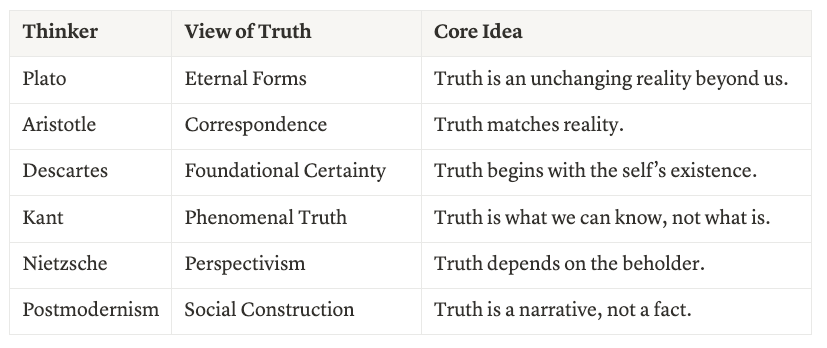
These ideas aren’t just relics; they’re earnest attempts by man to understand, each revealing a facet of truth’s complexity. But they leave us asking: is truth a distant ideal, a practical agreement, a personal discovery, or a fleeting illusion? The Bible steps into this fray with a claim that upends the debate.
Truth Through a Biblical Lens
In the Gospel of John, Jesus doesn’t define truth, He embodies it. “I am the way, the truth, and the life,” He says (John 14:6). This isn’t a proposition to dissect; it’s a person to know. Truth, here, becomes relational, alive, walking among us.
Truth, here, becomes relational, alive, walking among us.
When He tells His followers, “You will know the truth, and the truth will set you free” (John 8:32), He ties truth to liberation from sin, from lies, from the chaos that binds us. Pilate, staring truth in the face, misses it, perhaps because he’s looking for a theory (like many others across history as well) when truth is standing there, bleeding and breathing.
Scripture doubles down: “The sum of your word is truth,” says Psalm 119:160, “and every one of your righteous rules endures forever.” God’s word (His law and promises) is a compass, a light in the darkness (Psalm 119:105). The Old Testament hammers this home with commandments against falsehood (Exodus 20:16) and praise for those who “act faithfully” (Proverbs 12:22). Truth isn’t abstract; it’s moral, practical, a way of being that reflects God’s character.
Truth isn’t abstract; it’s moral, practical, a way of being that reflects God’s character.
If truth is just perspective or power, then Christ’s claim that he is the truth (John 14:6) becomes one voice among many, stripped of its weight. But the biblical narrative doesn’t bend to relativism; it stands firm, calling us to choose. Philosophy sharpens our minds, teaching us to question and reason, but faith roots us in an absolute truth that’s personal, eternal, and transformative.
Consider that encounter with Pilate again. Jesus says His kingdom isn’t of this world, that His mission is to testify to truth (John 18:37) and that every one who is of truth will listen to his voice. Pilate’s response, “What is truth?” is the cry of a man lost in Rome’s pragmatism, blind to the divine reality before him. The biblical view doesn’t just offer answers; it demands allegiance, a life aligned with the One who is true.
Truth and Right Living
This isn’t just heady stuff; it’s a guide for life. Living truthfully matters because chaos creeps in when we don’t expect it. Lies fracture us, whether we’re deceiving others or ourselves. Truth in the inward being, as Psalm 51:6 urges, heals, aligning us with reality and with God. For those called to disciple others (all of us), this is vital. A life of integrity, defined as the place where words and deeds match and carries a weight that empty rhetoric can’t. Truth sets us free not just spiritually but also mentally as we are brought peace from the lies, letting us stand tall amid life’s storms as Paul did in keeping good conscience (Acts 24:16).
Truth in a Post-Truth World
We’re in a strange age, dubbed “post-truth,” where feelings trump facts and narratives drown out reality. Misinformation spreads like wildfire, and discerning truth feels like grasping smoke. At night I am reading a book on fallacies with my kids because, as a parent, they are in a world where truth is struggling. Deception lurks in deep-fakes, cocky and hallucinating AI, photoshopped images, selling the news, etc. Helping my kids be shrewd and able to handle the onslaught with a street-smart innocence through Scripture. The Bible’s response is clear: “All Scripture is breathed out by God and profitable for teaching, for reproof, for correction, and for training in righteousness” (2 Timothy 3:16). We’re not left adrift, God’s word and His Spirit guide us.
As disciples, we’re not just called to know truth but to live it.
As disciples, we’re not just called to know truth but to live it. That means sifting through the noise with reason, verifying what we hear, and embodying authenticity. In a world of shadows, we’re called to reflect the light of Christ, drawing others to the One who doesn’t just speak truth but is Truth.
The Call to Stand in Truth
Pilate’s question, “What is truth?” still hangs in the air as humankind wrestles with it, attempting answers from their own viewpoints. But the Bible points us to a person: Jesus, the truth incarnate, and to a word that endures. For those tasked with making disciples, this isn’t optional, and we are all tasked with this. Truth is our foundation, our weapon against chaos, our gift to a fractured world.
So, stand up. Seek truth with your mind, your heart, your whole being. Test what you hear, anchor yourself in Scripture, and live with integrity. The stakes are high! They are high not just for you, but for those you’re called to lead. Truth is the rock we build on, Truth is building His Church, Truth is coming again!
Key Citations:
So true, so true! Thanks for sharing
Yes! And it or He sets us free! Guarding truth by saturating my life in Scripture and especially reading Jesus in the gospels